11-Jun-2026
At the start of May, the OpenBind consortium (hosted at Diamond Light Source) announced its first public data release, containing 925 crystallographic binding events from 699 compounds, and associated affinity measurements for 601 compounds.
OpenBind is a consortium of 9 partners, including Diamond Light Source (part of Instruct Centre UK) and EMBL-EBI, which aims to produce high-quality open-source datasets with information on protein-ligand interactions. Specifically, Diamond’s XChem fragment screening and MX beamlines are used for rapid screening of protein-ligand structures via x-ray crystallography. Diamond then produces FAIR-compliant datasets and releases these publicly. This data can be used by researchers all over the world to train new AI models and accelerate small-molecule drug discovery.
The XChem beamline at Diamond Light Source has also has a key role in the FragmentScreen project. FragmentScreen represents a collaboration between several research infrastructures and industry partners. Co-ordinated by Instruct-ERIC, FragmentScreen has developed innovative instrumentation, workflows and experimental and computational methodologies to accelerate the development of new pharmaceuticals through fragment-based drug discovery. You can read more on the FragmentScreen website.
This is an important area, as current benchmarking approaches have shown that the current bottleneck in AI-based structure prediction is the availability of high-quality data on which to train AI models, and the accuracy of prediction by models depends greatly on similarity to their training data.
The target for the first OpenBind dataset was Enterovirus A71 (EV-A71) 2A protease. EV-A71 is the major cause of hand, foot and mouth disease, and represents a major threat to global public health. The 2A protease is required for viral replication, and so by providing high quality data of this protein, OpenBind aims to facilitate AI-based drug design for an anti-viral medication. As well providing binding data (available via Zenodo), the OpenBind release also provided benchmarking data (available via GitHub) and experimental protocol information (available via protocols.io).
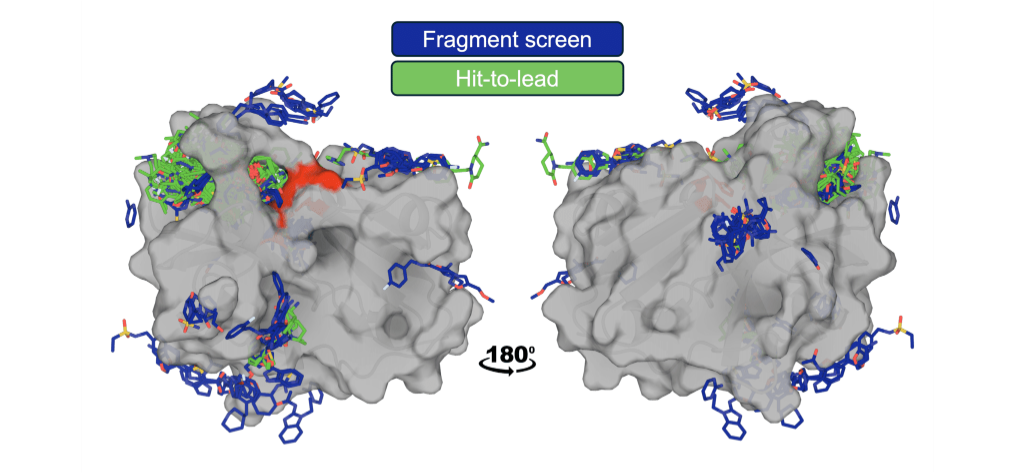
Structural coverage of ligand binding to EV-A71 2A protease. EV-A71 2A protease is shown with ligands from the OpenBind release overlaid, illustrating the density of experimentally observed binding modes generated through the fragment screen and follow-on compounds. Figure provided by OpenBind